Thursday, May 16, 2013

TX Electronic Voter Registration Reform

A recently passed Texas law reforms electronic voter registration. HB 2263 does not directly apply to initial electronic voter registration. Rather, it reforms how voter registration certificates (registration cards) are requested electronically and how they will be delivered.

HB 2263 has passed both houses of the Texas 83rd Legislature and is bound for Governor Perry's signature.

The new law enables voters to request replacement voter registration certificates electronically. However, it mandates those new certificates be mailed only to the address on record with the Secretary of State.

Voters can now request the new certificate via email or other electronic means. In addition, voters can make the request via telephone. However, changing address requires the request to be made in-person. The replacement cards are only in the event of damage or loss.


obtain a replacement certificate by: 
             (1)  delivering a written or electronic[, signed] notice of the loss or destruction to the registrar; or 
             (2)  telephoning the registrar to request a replacement
       (b)  A replacement certificate requested electronically under Subsection (a)(1) or by telephone under Subsection (a)(2) may be sent only to the mailing address on the voter's registration records.

The registrar (under the Secretary of State) must maintain a hard-copy of the request attached to the registered voters' records.


       (d) [(c)]  The registrar shall retain a written or electronic [the] notice submitted under Subsection (a)(1) on file with the voter's registration application. If the voter requests a replacement registration certificate by telephone under Subsection (a)(2), the registrar shall make a written record of the request and keep the record on file with the voter's registration application.


The full law as enrolled and forwarded to the Governor's Office is available here.

Affects On Voter Registration Fraud


Mandating electronic voter registration replacement requests return a certificate only to the residence of record may help to combat voter fraud. Some individuals perpetrating voter fraud will request replacement cards under a stolen identity, attempting to receive them at a new address. The criminals will then vote in place of the actual registered voter.

However, this law may also permit another form of voter fraud. In some cases, voter registration volunteers will assist voters in registering. However, they put a different address on the registration. The registrations then go to someone intending upon fraudulently using the registration to vote in place of the intended registered voter. Should the fraudulent address be substituted on the initial registration form, the voter will not be able to receive a replacement card.

Other new laws may assist in prevention of the second scenario. For example, one new law restricts how many early and absentee ballots a voting assistance officer/volunteer may return to 10. Others require certain proof of residence and identity when initially registering to vote. Combined with HB 2263, they may better increase voter integrity in Texas.

Wednesday, May 15, 2013

Texas Education Reform Targets Truancy

Three truancy related bills are circulating the Texas state legislature.

The previously reported SB 1234 establishes programs to prevent and combat truancy. The law also makes truancy a criminal offense. The bill has passed the Texas Senate. The bill has circulated the various House committees and submitted with a favorable recommendation. It may soon see a house floor vote.


SECTION 7.  Subsection (e), Section 25.094, Education Code, is amended to read as follows: 
       (e)  An offense under this section is a Class C misdemeanor punishable by a fine not to exceed: 
             (1)  $100 for a first offense; 
             (2)  $200 for a second offense; 
             (3)  $300 for a third offense; 
             (4)  $400 for a fourth offense; or 
             (5)  $500 for a fifth or subsequent offense.


Two related bills originated in the Texas House of Representatives. HB 1021 designates judicial jurisdiction for hearing cases regarding the criminal charge of "truancy". This truancy bill is directed at truant students. The House passed the bill. It has been engrossed and forwarded to the Texas Senate.


(2)  a justice court designated to hear cases arising under this section [of any precinct] in the county in which the individual resides or in which the school is located, or if no justice court is designated, a justice court of any precinct in the county in which the individual resides or in which the school is located;


The second truancy bill targets the parents of truant students, if they are accused of directly causing the truancy or negligently failing to cease the truancy.


AN ACT 
relating to venue for the offense of a parent contributing to a child's failure to attend school.
 BE IT ENACTED BY THE LEGISLATURE OF THE STATE OF TEXAS: 
       SECTION 1.  Section 25.093(b), Education Code, is amended to read as follows: 
       (b)  The attendance officer or other appropriate school official shall file a complaint against the parent in:
             (1)  the constitutional county court of the county in which the parent resides or in which the school is located, if the county has a population of 1.75 million or more; 
             (2)  a justice court designated to hear cases arising under this section [of any precinct] in the county in which the parent resides or in which the school is located, or if no justice court is designated, a justice court of any precinct in the county in which the parent resides or in which the school is located

Possible Intentions of Truancy Bills


Truancy can be a problem for Texas public schools. Some Texas schools have begun employing RFID chips in student ID cards in order to track attendance. This practice has already drawn controversy since the school districts admitted that low attendance numbers inversely affect state and federal funding. If students aren't showing up to school, the schools do not receive ADA funding.

ADA Funding is the program that allocates some of a school's financing based upon Average Daily Attendance. A calculations is done to determine the average attendance and how much, per student, per day, the school receives. While the program could easily be reconfigured into a voucher program, it currently is used for only public and some open-enrollment charter schools.

In effect, it is a "bonus" given to the school based upon the number of students enrolled and how many actually attend a minimum portion of a school day. It is also a means to redistribute wealth. See this publication from the Texas Education Administration (TEA) on how ADA and other school financing programs work.

In many areas of the state, drop-out and truancy rates may be responsible for lower than expected school assessments and ratings. Texas prides itself of the achievements of its public and open-enrollment charter schools.

Texas has a growing economy. Many companies are relocating to Texas due to many opportunities for growth and prosperity. Those employers need skilled and educated employees. Most programs that create those skilled workers and jobs require a high school diploma or equivalent. Curbing truancy is essential to continuing this growth.

The growing drop-outs and will be unable to fill those positions. In addition, they will increase the number of unemployed workers in the state. Along with the lack of employment opportunities due to a lack of education and certification, these drop-outs will increase tax-payer burdens for programs such as SNAP (food stamps), medical expenses, and housing subsidies.

Truancy Bill Help Immigration Reform


The truancy bills are also intended to assist immigration reform. Many students become truant due to their immigration status. Children smuggled across the border at a young age are raised as though they are American citizens. However, they are in the country illegally due to no action of their own. These students commit truancy in order to avoid deportation or prosecution.

Furthermore, the bills target so-called "anchor babies". "Anchor babies" are native born American citizens of illegal immigrant parents. Out of fear of deportation or prosecution, the parents will remove the students from school. The students and parents are then guilty of truancy.

The programs to prevent and combat truancy place these students into state-directed programs established by SB 1234. The intent is to keep them in school and the parents from fleeing to elsewhere in the US. If the children are also in the country illegally, the bill may inspire them to self-deport. In the case of "anchor babies", the programs make it more difficult for the illegal immigrant parents to leave the country with the American citizen child.

Possible Implications of Truancy Bills on School Choice


The three bills draw questions from advocates of school choice. The largest demographic of school choice advocates affected are those who promote and participate in home-schooling.

Though new Texas laws prohibit use of the Common Core State Standards Initiative and other nationalized scholastic standards, there is much controversy over the CSCOPE program. Many in opposition of CSCOPE claim it is a "backdoor effort to sneak Common Core" into Texas school curricula. Members of the Texas Legislature, such as Senator Patrick, have been working to reform and regulate CSCOPE.

However, many parents are still concerned. Some of those concerned parents are seeking and researching the option of home-schooling their children. Many national studies on home-schooling have revealed that home-schooled students perform better in colleges and universities.

These truancy bills may be seen to target home-schooling households. None of the three bills address home-schooling. The criminal offenses they create appear as though they can be used to prosecute home-school families under the crime of "truancy".

This seems to take education reform and school choice initiatives in a reverse direction. Parents considering home-schooling are urged to review Texas state laws regarding home-schooling, truancy, school choice, education code, education standards, and other associated laws in making their decisions.

Tuesday, May 14, 2013

TX Laws Fight Sex Slavery & Human Trafficking

The Texas 83rd legislature passed two laws concerning human trafficking and sex slavery. A third has passed the state House and will likely pass the Senate. Other bills are still being considered, but are likely to also pass.

SB 92 (Juvenile Court For Possible Victims of Human Trafficking) Passed, Enrolled, Sent to Governor

SB 92 is a new law pending execution and enactment by Governor Perry. The bill addresses judicial and court jurisdictions and considerations for children who may have been victims of human trafficking. (Full text of the law as passed.)

It allows the court to defer judgement in order to allow for other programs to assist possible human trafficking victims, specifically those under the age of 18.


       Sec. 54.0326.  DEFERRAL OF ADJUDICATION AND DISMISSAL OF CERTAIN CASES ON COMPLETION OF TRAFFICKED PERSONS PROGRAM. 
      (a)  This section applies to a juvenile court or to an alternative juvenile court exercising simultaneous jurisdiction over proceedings under this title and Subtitle E, Title 5, in the manner authorized by Section 51.0413. 
       (b)  A juvenile court may defer adjudication proceedings under Section 54.03 until the child's 18th birthday and require a child to participate in a program established under Section 152.0016, Human Resources Code, if the child: 
             (1)  is alleged to have engaged in delinquent conduct or conduct indicating a need for supervision and may be a victim of conduct that constitutes an offense under Section 20A.02, Penal Code; and 
             (2)  presents to the court an oral or written request to participate in the program. 
       (c)  Following a child's completion of the program, the court shall dismiss the case with prejudice at the time the child presents satisfactory evidence that the child successfully completed the program.
The new law addresses any victim of Texas Section 20A.02 Penal Code. That is the current law regarding Human Trafficking. In many cases, human trafficking is done for slavery purposes. Many times the slavery is work in "sweat shops" or other indentured labor. The "indentured labor" many times means working in the so-called "sex industry" and "adult entertainment industry".
 
(3)  traffics another person and, through force, fraud, or coercion, causes the trafficked person to engage in conduct prohibited by:
(A)  Section 43.02 (Prostitution);
(B)  Section 43.03 (Promotion of Prostitution);
(C)  Section 43.04 (Aggravated Promotion of Prostitution); or
(D)  Section 43.05 (Compelling Prostitution);


In the cases of children, Section 20A.02 adds:

(7)  traffics a child and by any means causes the trafficked child to engage in, or become the victim of, conduct prohibited by:
(A)  Section 21.02 (Continuous Sexual Abuse of Young Child or Children);
(B)  Section 21.11 (Indecency with a Child);
(C)  Section 22.011 (Sexual Assault);
(D)  Section 22.021 (Aggravated Sexual Assault);
(E)  Section 43.02 (Prostitution);
(F)  Section 43.03 (Promotion of Prostitution);
(G)  Section 43.04 (Aggravated Promotion of Prostitution);
(H)  Section 43.05 (Compelling Prostitution);
(I)  Section 43.25 (Sexual Performance by a Child);
(J)  Section 43.251 (Employment Harmful to Children); or
(K)  Section 43.26 (Possession or Promotion of Child Pornography);


SB 94 (Civil Liability For Sex Slavery) Passed, Enrolled, Passed to Governor

 SB 94 concerns "compelled prostitution". (Full text of the law as passed.) Compelled prostitution is synonymous with sex slavery. The new law makes human traffickers involved in sex slavery as well as other "pimps" liable for damages under civil suits, in addition to any criminal proceedings.

       Sec. 98A.002.  LIABILITY. (a)  A defendant is liable to a victim of compelled prostitution, as provided by this chapter, for damages arising from the compelled prostitution if the defendant: 
             (1)  engages in compelling prostitution with respect to the victim; 
             (2)  knowingly or intentionally engages in promotion of prostitution or aggravated promotion of prostitution that results in compelling prostitution with respect to the victim; or
             (3)  purchases an advertisement that the defendant knows or reasonably should know constitutes promotion of prostitution or aggravated promotion of prostitution, and the publication of the advertisement results in compelling prostitution with respect to the victim.

       Sec. 98A.003.  DAMAGES. (a)  A claimant who prevails in a suit under this chapter shall be awarded: 
             (1)  actual damages, including damages for mental anguish even if an injury other than mental anguish is not shown; 
             (2)  court costs; and
             (3)  reasonable attorney's fees. 
       (b)  In addition to an award under Subsection (a), a claimant who prevails in a suit under this chapter may recover exemplary damages.

HB 793 (Punishments For Human Trafficking) Passed House, Engrossed.


HB 793 better defines what acts are considered associated with human trafficking. It includes aggravated offenses for those who smuggle people and trespass on private lands while armed.

If passed, this bill will enhance the defense and protection of private property, especially those lands used for agricultural businesses such as ranches, orchards, and farms. The full engrossed version of the bill as passed to the Senate is available here.


(a)  A person commits an offense if the person intentionally:
             (1)  uses a motor vehicle, aircraft, or watercraft to transport an individual with the intent to: 
                   (A) [(1)]  conceal the individual from a peace officer or special investigator; or
                   (B) [(2)]  flee from a person the actor knows is a peace officer or special investigator attempting to lawfully arrest or detain the actor; or 
             (2)  assists, guides, or directs three or more individuals to enter or remain on agricultural land without the effective consent of the owner.

Collateral Effects of Human Trafficking and Sex Slavery


Human Trafficking and Sex Slavery activities usually coincide with illicit drug trafficking. Drug cartels will often work in conjunction with sex slavers and human traffickers. Drug cartels will often employ human traffickers to assist in providing "mules" from among the "coyotes" prey.

They perform these actions with no regard or respect for private property. In some cases, cartels and human traffickers have terrorized property owners along the borders of Texas and Arizona into fleeing their land in order to allow the cartels and traffickers to squat on the land with relative impunity. Those who resist the cartels and traffickers fear meeting the same fate as Arizona rancher Robert Krentz, who was assassinated by a drug cartel.

Human traffickers often indenture the border-jumpers they assist. Carrying illicit drugs across the border is one task traffickers force upon their prey as part of the payment for being smuggled across the border. Many times they also indenture the prey into prostitution and pornography. The most likely victims of this form of slavery are young women between 10 and 20 years of age. However, the activity is not only limited to females.

In addition, human traffickers will assist individuals associated with international terrorism to infiltrate the United States. The drug cartels have networked with these extremist groups. Some of these groups can facilitate the trade of opiates and other illicit substances. In return, the cartels assist them in infiltrating the US. Many times, the infiltrations are done in conjunction with human trafficking of sex slaves.

Some of these terrorists go so far as to purchase teenaged girls to be their sex slaves.

Their acts do not end in the border states. That is where they begin. Once inside the US borders, they disperse to states away from the border in order to continue their illicit activities in more permissive areas. They know that citizens of South Dakota are far less likely to look for illegal immigrants, sex slaves, and like than citizens of Sierra Vista, AZ or El Paso, TX are.

The human trafficking of sex slaves is not a one-way street. US Citizens are also abducted or otherwise coerced. They are then transported out of the US. One out of the US, it is far less likely that US law enforcement will pursue attempts to locate and rescue the victims. From Mexico, they are transported around the world.

Major General (ret) Scales addresses these issues in his Foreward to Texas Agriculture Commissioner Todd Staples's book Broken Borders, Broken Promises.

Monday, May 13, 2013

Why Conventions Matter -- BlogCon 2013

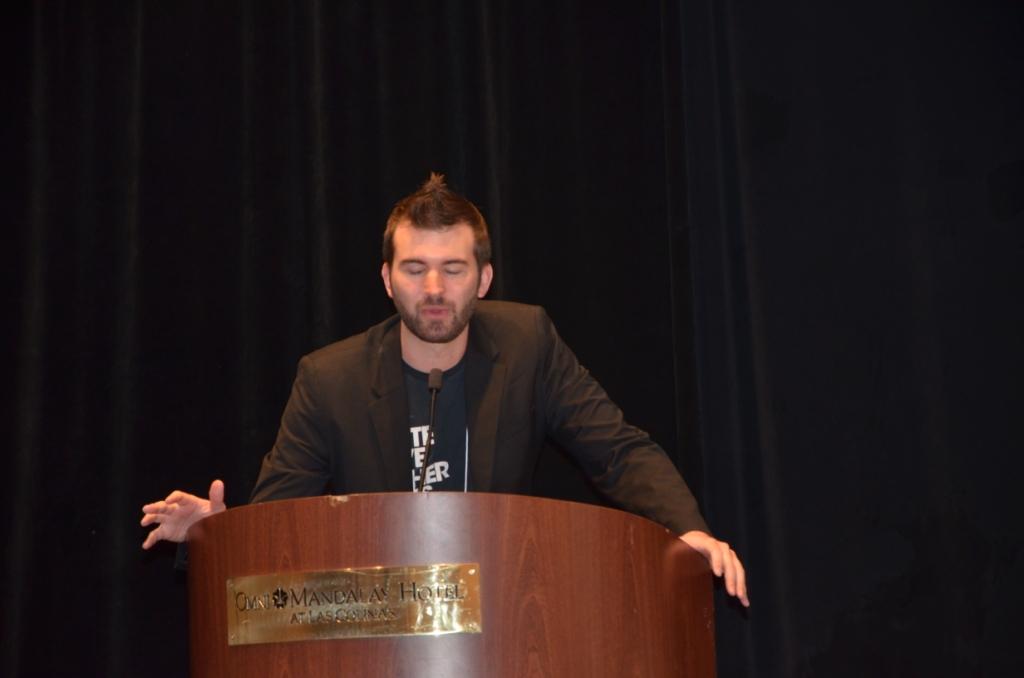
Steve Crowder opens BlogCon 2013 in Dallas, TX
Copyright 2013 by P-G Matuszak
Conventions matter.

These days we have comic book conventions. We have gamer conventions. We have Live-Action Role-Play conventions.

We have conventions for Star Trek, Doctor Who, Star Wars, Game of Thrones, and Firefly fans.

Inside each of us is a "Con Geek". The reason is simple. Everybody has interests and hobbies. It is refreshing, entertaining, informative, and fun to hang-out with like-minded people. For those of us who feel like isolated members of some "fringe" subculture, these conventions allow us to be with our communities. They let us know that we are not alone.

Contributors of Mental Aikido have attended many conventions. The first of any type can be overwhelming, at least for the first 15 minutes or so.

My first convention was the 20th Anniversary of Doctor Who, 1984. Other fans of the show may debate that the show was 20 in 1983. The first episode aired in December 1963. Its first full year aired in 1984, though.

I was star struck. Colin Baker, who was  the current "Doctor" at the time, accosted and assaulted a member of my group. She was wearing a hand-knit replica of Tom Baker's iconic scarf. Colin stopped her, mussed up the scarf, then adjusted it to more accurately reflect the way Tom wore it in the show. I just stood there with my jaw on the ground.

I also had the second and third doctors sit down and flank me in the audience of a panel discussion. They were supposed to be members. Instead  they joked that their schedules stated they were supposed to attend, not participate. It was great to meet Jon Pertwee and Patrick Troughton.

I have also attended several conventions within the Gothic subculture. I used to DJ goth gatherings on weekends for extra money while I was still in the military. It was great to "be myself" among other goths, especially "net-goths" from more rural areas who didn't have many other goths to socialize among, other than on old alt.goth newsgroups.

Then there are the numerous gaming and LARP conventions contributor Jared Royka and I attended as representatives of our local Camarilla/Mind's Eye Society chapter.

Members of various professional organizations have their conventions, as well. In fact, contributor Melissa Matuszak-Fosler is scheduled to present at one such convention in the near future.

Even "Cheetos Brigade" conservative bloggers have our conventions. There are several throughout the year.

This past weekend, Freedomworks, with assistance from Glen Beck's The Blaze, hosted BlogCon 2013. This, the fourth conservative bloggers' convention, was held near Dallas, Texas.

The event brought together conservative bloggers, commentators, and new-media journalists from around the country to discuss current issues, the political landscape, and the importance of accurately reporting news from the local to international levels.

Several key speakers addressed the crowd.

While attendees were still registering and collecting bags of SWAG, Todd Staples hosted bloggers for lunch. Todd Staples is Texas's agriculture commissioner. Due to the responsibilities of his current office, Todd has
garnered a unique view of border security and illegal immigration. His new book, Broken Borders, Broken Promises, addresses many of the issues to include a need to streamline legal employment visas in order to benefit US agriculture businesses.

Steve Crowder opened up the convention officially with a short, rousing speech. Those unfamiliar with Mr. Crowder's work should browse through his YouTube channel. Be prepared to laugh and be informed. One thing Steve stated set the tone for the convention. "I started in comedy and doing commentary spots on television. I arrived when I attended my first BlogCon and busted into 'new media'."


Steve Crowder, Chris Loesh, and other BlogCon2013 speakers appeared in this music video in 2012:


On a personal note, our daughter loves the song (and video) by Powdered Zombies. She always asks when Steve and Chris will make another music video.

"Powdered Zombie" Chris Loesch flanked by Emily Zanotti (left) and John Brodigan (right) of Misfit Politics
Copyright 2013 by P-G Matuszak
Many may think it hard to follow a media icon such as Steve Crowder. Those who believe that may have found themselves overwhelmed by Deneen Borelli.

Deneen gave another great speech. Just as other Tea Party women, such as Michelle Malkin and Dana Loesch, Deneen's speeches should not be missed. It matters little what your political ideology may be, Deneen always has something you need to hear. Her book, Blacklash, is a must read for all.

Deneen Borelli (R) and Melissa Matuszak-Fosler
Copyright 2013 by P-G Matuszak
The rest of the convention continued with great panel discussions and presentations from a myriad of great people on topics ranging from the implications of Obamacare implementation to the importance (and difficulties) of blogging stories of local significance.

Dean Clancy gives an update on the future affects of the PPACA
Copyright 2013 by P-G Matuszak


Melissa and I were ecstatic meeting Lou Ann Anderson, Sarah Marie Brenner, Lady Liberty and Liberty Speaks. These are great women and great reporters. Read them.

We socialized with PJ Media's "Vodka Pundit", Steve Green. Steve is an awesome guy.

Melissa and Dana Loesch chatted about motherhood and education while grabbing some BBQ at Gilley's. Dana was assisting with memorial and funeral arrangements for Chip (Rest in peace, patriot). We thank her for taking a few second for a picture:

Melissa Matuszak-Fosler and Dana Loesch
Copyright 2013 by P-G Matuszak


She also was subjected to a lubricated Scott Jacobs while I was catching up with Mandy Nagy and John Gabriel.


It was also great to see David Darnell and Loren Heal again. David was quick to help Melissa feel welcome and among friends. 

As with previous BlogCons, I met many great bloggers; some new, some established. Despite all of the great presentations, that is the real purpose of the conventions. They allow us to meet and network with people face to face. There are far too many great people to list by name. Those who use Twitter can follow many of them on this Twitter-List of Blogcon 2013 attendees. Each and every one of them is hard-working, unique, and has something to say that is worth paying attention to.

So many great people collected  under one roof. Though we had to leave early, undoubtedly we will be suffering form BlogCon withdrawal for the next several days.

In the meantime, please prompt BlogCon virgin, Melissa Matuszak, to write her own perceptions.

We would like to extend our deepest gratitude to Kristina Ribali and the staff at Freedomworks for another great convention. Your hard work is much noticed and appreciated.

Kristina Ribali
Copyright 2013 by P-G Matuszak


Other Pictures:


"Misfit" Brandon Morse looking like he is still recovering from the Kruiser Cabana
In reality, he didn't miss a beat. He was about to emphasize a key point.
Copyright 2013 by P-G Matuszak

@ExJohn John Gabriel waiting for his chance to speak while Ace of Spades (not pictured) finishes his point.
Copyright 2013 by P-G Matuszak


Radio Personality Dana Loesch speaks on challenging the Mainstream
Copyright 2013 by P-G Matuszak

"Fingers" Malloy
Copyright 2013 by P-G Matuszak

James O'Keefe of Project Veritas
Copyright 2013 by P-G Matuszak

Lee Stranahan
Copyright 2013 by P-G Matuszak

Mental Aikido's Melissa Matuszak-Fosler reacting to one of the great speakers
Copyright 2013 by P-G Matuszak

Freedomworks' Matt Kibbe signs Amy Miller's copy of his book Hostile Takeover
while Melissa shows off her recently signed copy.
Copyright 2013 by P-G Matuszak

.

.

Melissa's Musings: "The Hunger Games"- a Possibility?

Courtesy of Amazon.com


According to Wikipedia the Hunger Games is a book of fiction based in a place called "Panem", where North America once stood.  After a battle, a King took charge in the Capitol.  The hunger games is an event where one boy and one girl from each of the 12 districts are selected at random to participate in a deadly televised game.  Only one child (the participants range from age 12 to 18) is crowned the winner.  According to Rotten Tomatoes, the hunger games is a sort of punishment for a past uprising and an "intimidation tactic" from the government. The story is focused on two main characters (Peeta and Katniss) who are both from district 12 and are pitted against each other in a race for survival.  Great work of fiction. 

This kind of sounds familiar doesn't it?

The Hunger Games can happen, and our government is close to this reality already.  The political overtones are evident in the movie.  The rich people and the poor are divided, and the movie does not talk about how the rich got that way (hard work was not discussed in the movie- and this appeals to the Liberals) as far as the Conservatives, too much government control leads to tyranny.

The government has been trying to regulate and bypass the first amendment via attempts to control the internet (remember SOPA and PIPA?) and recently the government has been taking more and more control (debt, the housing market,  unemployment numbers, medical care, an on and on).  You have to be living under a rock to not see what is happening to the United States Government.  Our government is lying to us, and it has too much control already.

These ideas presented in "The Hunger Games" are important ones to consider, not tomorrow, but NOW.  There is an election coming up, and the challenges of this country's future are at stake. The people of the United States are presented with challenges, that if not accepted could lead to the Hunger Games being a reality.


 Article and review originally appears at Melissa Matuszak-Fosler's Melissa's Musings.  

Friday, May 10, 2013

Who's Got Our Back Now?

After the latest hearings on the terrorist attack in Benghazi, some are experiencing tremors in the public trust.

Mr. Hicks revealed many eye-opening details.

We found out that the CIA and the State Department had editorial privilege over much of the reporting in the Mainstream Media.

A video was falsely accused of being the catalyst.

The attack was planned well in advance.

Instead of US Marines, Secretary of State Clinton hired local security personnel, some of whom may (or may not) have been linked to Ansar al-Sharia, the Al Q'aeda affiliate who conducted  the attack.

Through all of this, many people are feeling less and less confident in the executive branch. They couldn't protect Ambassador Stevens. That is one of the primary missions certain military units train to do.

So, to quote a song by Creed, "Who's got my back now..."


The song echoes one particular line over and over. It applies to Benghazi as well as so many other issues, such as Fast and Furious, during this administration: 

"What is the truth, now? Tell us the truth, now!"

This all leaves us wondering if we will ever really know what happened and why. But the evidence before us already is pretty damning.

Many are calling for impeachment.

They forget that the majority party in the US Senate bends its knee to Obama, their messiah.

Impeachment may be a pipe dream.

So, who's got our back?

Look to the "maverick" senators and representatives who are so vilified by the mainstream media.

Look to Paul Ryan.

Look to Senator Ted Cruz.

Look to Mike Lee and Rand Paul.

We need to look at Darryl Issa. 

They don't have our backs. No. They are deep in the fight. We need to have their backs so they know their being in the fight is appreciated.

It is up to us, the citizens, to remind our elected representatives to do their jobs. We need to point at these men and say "See! That is how it's done!". 

"All that has been devastated can be recreated..."

So, who has our backs?

Well, if you are a conservative, I have your back.

At times I may not 100% agree with you. That is more than fine, it is cool. But I will back you when you want your voice heard.

Erick Erickson, I have your back.

Brandon Morse, I have your back.

Dana & Chris Loesch, I have your backs.

Kurt Schlichter, Brodigan, Fingers, Sarah Marie, Pam Geller, Michelle Malkin... I've got your backs.

YOU! Yes You, reading this. Just because you are not named specifically, don't feel left out. I've got your back.

Now, I ask:  Who's got my back, now?

Store & Transport Passed; Campus Carry Still Waiting

The Texas House passed Campus Carry legislation and passed it to the state Senate.

The bill, HB 972, permits campus carry, or the authorization for concealed carry license holders to carry their weapons and ammunition on college campuses. The bill is still being discussed and reviewed by the senate committees.

Some Second Amendment advocates have stated that HB 972 allows colleges too much authority to restrict or regulate areas on campus where firearms will and will not be allowed. The full text of the bill is available here for review. Most leeway is granted only to private institutions. Those institutions do reserve property rights. Infringement of  those rights, just as infringing upon second amendment rights,must be carefully considered in any and all legislation.

Meanwhile, Senator Glenn Hegar (Katy, TX) sponsored SB1907. The bill was an attempted compromise. Instead of allowing campus carry so that students could protect themselves from rape and other violent crimes on campus, it allows them to store their firearms and ammunition in their vehicles. It also allows for concealed carry license holders to transport their firearms and ammunition on campus. They just cannot carry them on their persons'.

Thursday May 9, 2013, the Texas House passed SB 1907. The campus storage and transportation bill will now go to Governor Perry for consideration and action.

For more information on the Texas Campus Carry bills, please read "Campus Carry Pushed Through Texas House".

For further reporting on the Campus Firearms Transportation and Storage Act, please read "Not Quite Campus Carry in Texas".

Thursday, May 9, 2013

NO! Common Core In Texas

The Common Core State Standard Initiative, called CCSSI or "common core", is a subject of national debate.

The state of Texas has not yet adopted Common Core. Based on a bill that passed the State House on May 7th, it seems unlikely Texas will adopt the initiative any time soon.

HB 462 was written to clarify how teachers are assessed or appraised. It also addresses how standards for curricula will be developed and how metrics are determined to grade student progress.

One point is clear in the bill:  common core is not to be used.

       (b-1)  In this section, "common core state standards" means the national curriculum standards developed by the Common Core State Standards Initiative. 
       (b-2)  The State Board of Education may not adopt common core state standards to comply with a duty imposed under this chapter.
       (b-3)  A school district may not use common core state standards to comply with the requirement to provide instruction in the essential knowledge and skills at appropriate grade levels under Subsection (c). 
       (b-4)  Notwithstanding any other provision of this code, a school district or open-enrollment charter school may not be required to offer any aspect of a common core state standards curriculum.


"Optional" national or federally directed standards are also blocked:


The commissioner may not adopt or develop a recommended appraisal process and criteria based on any appraisal criteria that incorporate the results of student performance on assessment instruments that are intended for national applicability or are enacted federally as optional criteria


The engrossed text of the bill, which has been passed to the Texas Senate, is available here.

The Case Against Common Core


The concept behind the initiative is to nationalize school curricula through a "bottom-up" approach. The more states that join the initiative, the better the chances of federalization.

National scholastic standards bring several key issues. Perhaps the greatest issue is one regarding social demographics. Subjects important to one demographic in Montana may not have any value to people living in Texas. A federalized curriculum removes those demographic considerations.

Another key issue with national standards is that implementation will remove parent and student choice. It will take responsibility out of the local community and give that authority to the federal government, despite the violation of the Tenth Amendment of the US Constitution. Local school boards will see their authority stripped. Parents and students will no longer have a direct line to those hired to govern education. The public education system will be in the hands of what many see as an already bloated and ineffective federal bureaucracy.

States that already have better performance ratings fear nationalized standards will impede their successes. They fear that the standards will lean more towards the "lowest common denominator". Thus they will fail to adequately challenge the students' performance. In addition, many fear, that once standards are nationalized, standards will be lowered if the majority of states complain the established standards are too tough.

The International Baccalaureate


Though the bill appears to block common core, it allows for the so-named "International Baccalaureate" programs.

IB programs are similar to common core. However, they are based upon an international common standard. It attempts to establish a global standard at a level above the US federal level.

The name is deceptive. It is made to appear to be a collegiate level option. However, the IB program begins in primary school and extends through college

In Texas, there are currently 50 schools participating in the IB program, with at least 35 more looking to join.

HB 462 allows College Advanced Placement (AP) and IB curricula and standards to be used to assess teachers and students.


 This subsection does not prohibit the use of college advanced placement tests or international baccalaureate examinations as those terms are defined by Section 28.051


Other Standardized Curricula


While the bill blocks use of Common Core, it does not address CSCOPE.

CSCOPE is another scholastic tool currently under political scrutiny. The controversial curricula of CSCOPE apply standards similar to those found in Common Core, as a form of backdoor application of CCSSI.

Furthermore, CSCOPE has come under fire due to several events throughout the state. Among those was the alleged persecution of a student in McAllen, Texas who refused to pledge allegiance to Mexico. In another, students were forced to dress in the full abayiah and hajab  worn by many Muslim women, particularly in more repressed societies. A third "alarm" was raised when some students returned home with mathematics worksheets that seemed to profess socialism and the redistribution of wealth.

For more information on CSCOPE, please refer to Lou Ann Anderson's numerous articles.

Wednesday, May 8, 2013

Campus Carry Pushed Through Texas House

A Campus Carry bill passed the Texas House of Representatives on May 7,2013. The record vote was 102 in favor and 42 opposed.

On March 14, 2013 the House Committee on Homeland Security and Public Safety had left the bill "pending in committee". Despite an immense amount of favorable testimony, the committee was reluctant to bring the bill to a floor vote.

When word of the intent to let the bill die without a floor vote, second amendment advocates began a grassroots campaign requesting the bill get proper consideration.

The bill was amended several times over the past few weeks.

HB 972 and it's identical companion bill in the Texas Senate, SB 182, would, if passed, allow students, faculty members and visitors with legal concealed carry licenses to carry their firearms on college campuses. The Senate concealed carry bill has remained in The Senate Committee on Criminal Justice chambers since January 2013.

The Texas Senate has just a few short weeks left to vote on both versions of the Campus Carry bill in order to get it passed during the 83rd legislative session.

Key Provisions of the Campus Carry Bill


The Campus Carry bill allows for concealed license holders to carry on college campuses, public or private, with certain limitations.

(b)  A license holder may carry a concealed handgun on or about the license holder's person while the license holder is on the campus of an institution of higher education or private or independent institution of higher education in this state.

The institutions themselves are allowed to regulate and restrict where on campus firearms may be stored, including dormitories and fraternity houses:

(d)  An institution of higher education or private or independent institution of higher education in this state may establish rules, regulations, or other provisions concerning the storage of handguns in dormitories or other residential facilities that are owned or leased and operated by the institution and located on the campus of the institution.

They cannot, however, create their own regulations concerning concealed carry licenses or appropriate use of lethal force:

(c)  Except as provided by Subsection (d) or (e), an institution of higher education or private or independent institution of higher education in this state may not adopt any rule, regulation, or other provision prohibiting license holders from carrying handguns on the campus of the institution.

Private institutions can adjust the rules on their private property with proper consultation and the posting of legal notifications:


(e)  A private or independent institution of higher education in this state, after consulting with students, staff, and faculty of the institution, may establish rules, regulations, or other provisions prohibiting license holders from carrying handguns on premises that are owned or leased and operated by the institution and located on the campus of the institution.
The full engrossed version of the House Campus Carry bill passed to the senate is available here.

Other Campus Carry Bills


The state senate passed SB 1907 in April. Falling short of Campus Carry, SB 1907 allows for individuals with concealed carry permits to lock their firearms and ammunition in their vehicles on college campuses. Concealed Carry License holders may also transport their firearms and ammunition on campus as long as they remain locked in their vehicles.

Second Amendment advocates similar to Students for Concealed Carry questioned the bill. It seemed a poor compromise that would do little to nothing in helping law-abiding citizens to protect themselves from violent crimes on college campuses.

Tuesday, May 7, 2013

Teacher Appreciation Week

My wife cam home from work with several bouquets of flowers. My first thought was that she was making a gesture of affection towards me. I asked if they were for me. She replied they weren't. My heart sank slightly, wondering who was moving in on my spouse.

Then I thought for a second. I asked if they were for my daughter. My wife responded that they were hers. Then she told me that she received them from several of the students at her school.

My wife is a teacher at a parochial head-start program. She's looking to branch into school counseling. Her graduate degree is in psychology, counseling and guidance. She's an internship and two tests away from her license. However, she needs two years as a teacher in order to work that job in the school system. So, she is currently a teacher.

She has been working this current job for about two weeks. It was a huge paradigm shift for her. She was used to counseling and social-working adults. So the flowers came as a surprise to both her and I. The real surprise for her was that they were all "teacher appreciation week" gifts.

The flowers provoked some thought and recollection.

Regular readers may look at past articles and believe I have no respect for teachers. That is far from true.

I taught at the collegiate and post-graduate levels. I taught associate and bachelor level courses to high school graduates that had joined the US Army to become intelligence analysts. One of them had a couple of PhDs and was a history professor at the University of Washington. He was rather impressed with how we accomplished our training in such a short period of time at the level we did.

I also taught graduate level courses to lieutenants, captains and majors. So, I do know a thing of two about creating rubrics, lesson plans, teaching plans, test development, Socratic method, Bloom's Taxonomy and Revised Taxonomy, Critical Thinking, the Adult Learning Model, and several other pedagogies.

I am far from blind to the dedication and effort required to be a teacher.

So, to show my true appreciation for those in the profession, I decided to write a special essay on the teachers who influenced me most. They did so not by just teaching the required material. Each also went that little extra and taught things beyond the curricula. I usually do not do "favorites". However, these few are the cream of the crop.

Dad

My father was my primary educator throughout my life. In many ways, he still is. The list of things he taught me is exhaustive. They include baiting a hook and riding a bike. They include painting and woodworking. They include finding my own answers and researching data. They include photography. They include ethics and morals. They include working hard to achieve a goal and the satisfaction of accomplishment.

My father was also a professional educator at one time. 

Mr. Kozul

I cannot name my 4th grade teacher. I can name my 3rd grade teacher only because of the controversy she spread. She had a habit of trying to force her religious views onto her public school students. Most of her students were catholic. She was new-born Christian and a fundamentalist.

I remember Miss Kaplan. But I do not recall if she was Kindergarten or 2nd grade. I just remember she was pretty and very Jewish. She was the "bright shiny" in a mostly Roman Catholic neighborhood.

But I have fond memories of Mr. Kozul. I was an advanced student. In 5th grade, I was placed into 6th grade classes, taught by Mr. Kozul. He made learning fun. He teased students, cutting up and tossing jibes. We quickly figured  out that the more he teased a student, the more impressed with the student he actually was.

Mr. Kozul fostered creativity and self-directed study. That is, if we worked hard and got the required coursework done, we were encouraged to learn something additional, for fun. He even allowed a small group of us to rewrite and perform a version of Romeo and Juliette.

He got me interested in Robert Frost's poetry and Jack London's books about the Alaskan tundra. He also taught me that "The ending is great. I highly suggest you read this book," is not appropriate for a book report. I wrote that for my review of The Ammityville Horror.  I didn't want to spoil the ending, considering I noticed he was just starting the book the day before the reports were due.

Mrs. Ameraal

I was subjected to her torture for two of my four years in High School. I had her for Sophomore year Honors English. Then, being the masochist, I took AP English my senior year. She was the only accredited AP English professor at the school.

I was also subjected to her throughout my junior year. She would walk up to me in the middle of the hallway or, worse, in the middle of a class. She thought I had some writing talent and continually brought me entry forms and requirements for writing contests. I entered most of them. I won a couple of them.

Mrs. Ameraal was a task master. She had high standards and did not waiver on any of them. For AP English, we had a long summer reading list. The second, third, and fourth days of class were all essay exams on those books. She taught the class as though it were a college class. Her intent was to cover four semesters worth of college level composition, creative writing, and literary analysis in one high school year.

She challenged thought. She prodded us to get into the minds of the characters and the authors. We even had to learn some Old English in order to read a couple of works. She wanted us to appreciate the original languages over modern translations.

As much as I teasingly remark about how awful it was to subject myself to her classes, I enjoyed them. They challenged me and kept me actively engaged. To this day, however, I won't openly admit to her that I didn't read Wuthering Heights until years later, yet still managed to ace the exam. 

Ft. Ron DesRosier

Father Ron, the punk rock priest. He wore a studded leather tie and made crude jokes in both French and English. He also surprised a few of my fellow students when he spoke Italian, Latin, German, and Danish. When it came to languages, this guy was smart.

He also was not an ideal priest. He had no problems telling tales of drunken debauchery from his younger days growing up in Paris.

He rode a motorcycle.

He also was  a mentor and a friend. When I needed an ear, he was magically there, listening, and offering sound advice.

Oh, despite his raspy speaking voice, he could sing.

He was also pretty quick to pull practical jokes on other teachers. 

Miss Donna Dumke

Donna was probably the most influential teacher I had. She was my Junior High teacher for several subjects. I had her for history in 7th grade. I had her for math in 8th grade. I had her for lunch in both grades.

Well, lunch was not a "class". However, Donna allowed a few of us to eat lunch with her two days a week in order to watch Doctor Who. The show was on from 10-12 on Sunday nights. During the summer, we could watch it. During the school year, though, we could not always manage to sneak downstairs to watch it.

So, Donna recorded it on her VCR. She would bring the tape in. On Tuesdays and Wednesdays we'd watch the show, or half of it.

She would also help us with homework. Payment for being in the Doctor Who club consisted of doing extra, advanced math homework. This happened both years.

In 8th grade, I had her for lunch the other three days of the week as well. Being advanced, she gathered up five of us and taught us algebra and geometry at the high school levels. We took the classes while munching on whatever we had packed in our brown bags.

Like Mr. Kozul in 6th grade, Donna seemed to enjoy teaching. She enjoyed challenging us then celebrating our successes when we overcame the challenges she hit us with.

She also enjoyed the white chalk marks on our foreheads when she beamed us with an eraser. Going to sleep was sure to get you tagged. But worse was when she'd say the name of the kid sitting in front of you. The next word was usually "duck", just as you'd feel the dusty eraser bop you in the head. It usually meant you made her laugh with some cheesy joke. It was all fine unless you were too thin-skinned and took it personally.

She knew how to treat things seriously that were serious, yet still manage to have fun with it all.


This week, thank the teachers that influenced you. Thank the good teachers that teach your children. Sure, there are the bad eggs out there. But know that most teachers are trying to do a job that is not easy. It's just worth it.